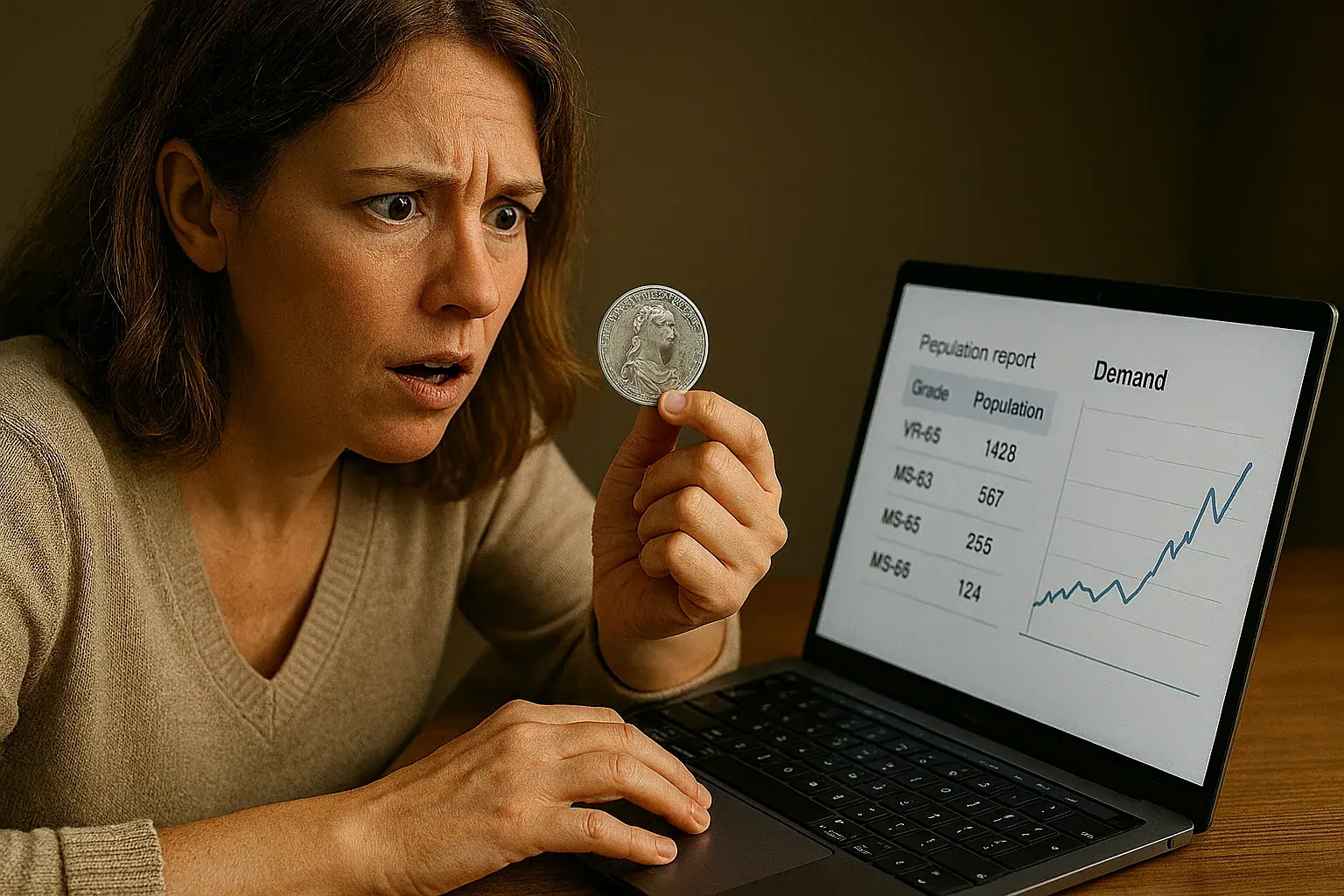
Searches for 1942 quarter value no mint mark usually point to one coin, but the market is not that simple. A 1942 quarter without a mint mark is a Philadelphia coin. That part is normal. The real split comes later. There is a regular Philadelphia issue struck for circulation, and there is also a Philadelphia proof coin with the same no-mint-mark look. They do not trade the same way.
That is why this date keeps confusing: one buyer sees a common silver quarter, another sees a proof. A third assumes the missing mint mark makes the coin scarce.
What “No Mint Mark” Means on a 1942 Quarter
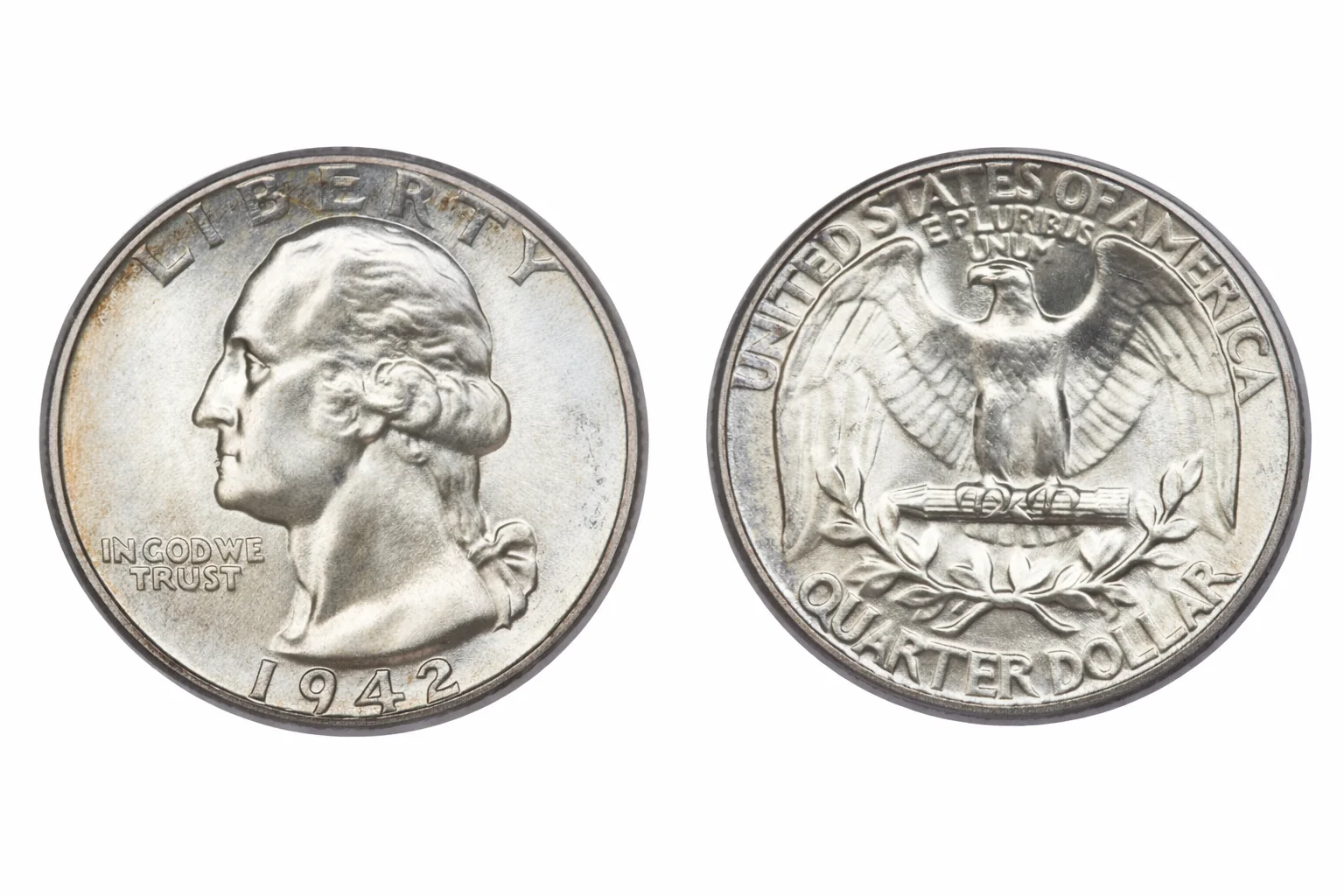
On this date, no mint mark means Philadelphia. It does not mean error. It does not mean a special issue. It does not add a premium by itself. The coin must be judged by its format and condition, not by the absence of a mint mark.
That is the first point to settle before checking the price. A 1942 no-mint-mark quarter can be one of two things:
- A regular strike made for circulation
- A proof coin made for collectors
The missing mint mark stays the same in both cases. The market does not.
Philadelphia Issue and Proof Coin: Two Different Markets
The regular 1942 Philadelphia quarter is a high-mintage circulation coin with 102,096,000 pieces struck. It is a silver Washington quarter struck for daily use. In worn grades, it behaves like many other pre-1965 quarters.
The proof is different from the start. The proof mintage is 21,123. This coin was made for collectors, not circulation. The market for proof quarters depends on mirrors, hairlines, surface quality, and top proof grades. It should not be priced like an ordinary Philadelphia coin from a bankroll or an old silver jar.
The basic split is easy to see in the table below.
| Version | Mint mark | Purpose | Mintage | Main value driver |
| 1942 regular strike | None | Circulation | 102,096,000 | grade, luster, marks |
| 1942 proof | None | Collector issue | 21,123 | proof quality, mirrors, hairlines |
This is where a coin value checker starts to make sense in a practical way. On a date with two different market lanes, the useful part is comparison. The Coin ID Scanner offers coin cards, saved examples, and value ranges in separate groups, so a proof is not treated like a normal circulation strike, and a regular strike is not priced like a proof.
Basic Coin Facts
The regular strike and the proof share the same core specifications. Both are Washington quarters designed by John Flanagan. Both are 90% silver and 10% copper. Both weigh 6.30 grams. Both measure 24.30 millimeters and have a reeded edge. The metal does not separate them. The market does.
The shared specifications are straightforward.
| Feature | 1942 Quarter |
| Coin type | Washington quarter |
| Designer | John Flanagan |
| Composition | 90% silver, 10% copper |
| Weight | 6.30 grams |
| Diameter | 24.30 mm |
| Edge | Reeded |
| Mint mark status | No mint mark on Philadelphia coins |
These facts matter for identification, but they do not tell the whole value story. A proof and a regular strike can share the same metal, same size, and same date while still sitting in very different price ranges.
Value Overview
Market Value of the Regular 1942 Philadelphia Quarter
The regular 1942 Philadelphia quarter is common in lower grades. Circulated examples are about $14.25 to $16.75 as of March 2026. That keeps the coin in normal silver-quarter territory when it shows clear wear.
The date becomes more interesting in better condition. PCGS shows how the market starts to widen in Mint State. Recent auction records give a useful picture: MS65 sold for $36 in 2019, MS66 sold for $66.51 in 2020 and $105 in 2021, and an MS67 example sold for $408 in 2022. At the very top, PCGS lists an auction record of $5,581 for an MS67+ coin.
That pattern is important. The coin is not rare because it lacks a mint mark. It becomes stronger only when the grade rises. The market for worn pieces stays modest. The market for strong uncirculated pieces is a different matter.
A short progression explains the regular issue better than a long price list:
- Circulated: silver-quarter level
- Lower Mint State: small to moderate premium
- Gem: stronger collector demand
- Top-end certified coins: auction-driven

Alt: Factors that affect the 1942 quarter value: format, grade, mirrors, hairlines, eye appeal, and attribution.
Market Value of the 1942 Proof Quarter
The proof quarter begins in a different place. The mintage is far smaller, and the buyers expect more. Surfaces matter. Hairlines matter. Mirrors matter. This is not a coin judged by silver content alone.
Recent proof sales show the gap clearly. PCGS auction records show PR67 examples selling at $168 and $240 in 2025, while a PR68 example sold for $1,560 in September 2025.
That makes the proof market easier to read. Mid-grade proofs stay accessible. Higher-proof grades rise fast. The upper end is much thinner, and the prices reflect that. This is why a 1942 proof cannot be discussed in the same breath as a normal circulated Philadelphia quarter.
1942 Quarter No Mint Mark Value Overview
The broad market picture becomes clearer when the two versions are separated. The table below combines circulated range with recent auction markers for stronger regular strikes and proofs.
| Version | Typical lower-range value | Where premiums begin | What moves the price |
| Regular strike, circulated | about $14.25–$16.75 | Mint State | grade and eye appeal |
| Regular strike, MS65–MS66 | tens of dollars to low hundreds | Gem levels | cleaner surfaces, stronger grade |
| Regular strike, MS67 and better | clear premium tier | top-end certified coins | condition rarity |
| Proof, PR67 area | collector premium | upper Proof grades | proof quality and surfaces |
| Proof, PR68 and higher | much stronger premium | near-top examples | mirrors, marks, scarcity |
The table supports one clear point: the missing mint mark is not the premium feature. The premium comes from format and condition. That is the center of the 1942 no-mint-mark market.
What Else Can Add Value?
The date has another layer beyond the normal coin and the proof. PCGS confirmed several recognized Philadelphia die varieties under the 1942 regular strike, including DDO FS-101 and DDR FS-801, FS-802, and FS-803. These are not part of the ordinary date market. They belong to the variety market.
One example is strong enough to make the point. PCGS lists an auction record of $5,875 for the 1942 DDR FS-801 in MS66. That does not describe the normal 1942 quarter. It shows what attribution can do when a recognized variety is present.
This adds one more practical lesson. A 1942 quarter no mint mark can fall into three separate lanes:
- Regular strike;
- Proof coin;
- Recognized variety.
That is another reason this date is often misread. People stop at the mint mark. The market moves later.
FAQs
Is a 1942 quarter without a mint mark rare?
No. The no-mint-mark format is normal for Philadelphia on this date.
Is every no-mint-mark 1942 quarter valuable?
No. Circulated regular strikes usually stay near normal silver-quarter levels.
Are 1942 proof quarters valuable?
Yes, but the market depends on the quality. Mid-grade proofs remain collectible but reachable. Upper-grade proofs can sell for much more.
Does silver content explain the full price?
No. Silver helps explain the lower range for worn regular strikes. It does not explain top Mint State or upper-proof prices.
What matters most for value?
First the format, then the grade, then any recognized variety.
Conclusion
The 1942 no-mint-mark quarter is easier to understand once the coin is placed in the right group. The regular Philadelphia issue is a common silver quarter in worn grades and a stronger collector coin in high Mint State. The proof is a separate collector issue with a lower mintage and a different price curve. The missing mint mark explains almost nothing on its own.Among free coin apps, rely on the Coin ID Scanner that can help from a different angle than a basic lookup tool. Its AI helper, saved coin cards, and collection features make it easier to keep regular Philadelphia pieces apart from proof coins and to compare those value lanes without mixing them together.